Tuesday, August 21, 2012

1st Brew! IPA

On Saturday, August 18, 2012 we broke in the new brewery with a Dogfish Head IPA 60 Min clone recipe I found online at the Homebrewtalk.com forum.  Here is the link for those interested:

http://www.homebrewtalk.com/f69/dogfish-head-60-minute-clone-ag-extract-25709/

The recipe looked like this:

  • 28 lbs - 2 Row Pale Malt
  • 12 oz - Carapils
  • 6 oz - Crystal Malt 60L
  • Hops
    • 1.5 oz Warrior
    • 1 oz Amarillo Gold
    • 1 oz Simco
    • 1 oz Simcoe (later for dry hopping)
    • 2 oz Amarillo Gold (later for dry hopping)
  • Yeasts
    • 2 Packets - Pacific Ale Yeast - White Labs 0041
    • 2 Packets - American Ale Yeast - 1056
  • Additives
    • 2 Whirfloc Tablets
    • 2 Grams Calcium Carbonate (Chalk)
    • 3 Grams Calcium Sulfate (Gypsum)
    • 2 Grams NaCl (Kosher Salt)
    • Potassium Metabisulphite
Being the Project Managers that Sam and I are, we worked out a step-by-step process we followed for our first brews to ensure we were not doing anything out of order.  This will probably be the only time I go into a bit of the step-by-step process, going forward will mostly just review what we brewed and results.

The process started by heating the water in the HLT (Hot Liquor Tank).  We filled that up to 20 gallons and then heated it up to 154 degrees.  While the water was heating we crushed our grains in our Barley Crusher grain mill.


Our first lesson came during the crush, which is to always make sure the cordless drill is fully charged!  Ended up having to use the hand crank for a bit of it.

Once the water was up to temperature we transferred hot water from the HLT to the MLT (Mash/Lauter Tun).  For this recipe we used 9.6 gallons.  This is calculated via a straight forward equation:

Strike water = (Mash Thickness X Pounds of Grain / 4) + liquid in hoses 
courtesy from Kal from www.theelectricbrewery.com

We were going for a Mash thickness of 1.25, so the equation looked like:

Strike Water = (1.25 x 29.125/4) + .5 = 9.6

After transferring this water, it needed to be heated a little and brought back up to temperature as it lost a little heat during the transfer process.  This only took maybe 10 minutes.  After it was up to temperature we slowly started scooping the grain into the MLT until it was all in.  During this process we were mixing it the whole time to ensure no dry clumps and a well mixed mash.

At this point we introduced our Brewers Salts (Chalk, Gypsum, Salt), stirred well, then took a Ph reading.  Our target Ph level is 5.2-5.3, we were coming in at 5.7 at this point.  To decrease that level we need to introduce an acid, and most brewers will use Lactic Acid at 88% concentration.  Very little is needed, we only added 4ml to the entire batch to bring down to 5.3.

Once we had all of our levels good, we started our Mash process for the next 90 minutes*

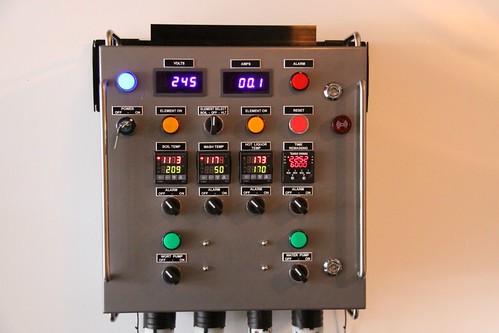
*Lesson 2, the timer needed to be programmed to reflect min:sec, it defaults to seconds.  We entered 9000 thinking it was set for 90 min and 0 second, but it was 9000 seconds.  We ended up with a 2.5 hour mash!  Fortunately I don't think it hurt much, mostly my pride.

The next phase is to Mash Out.  This is done by bringing the HLT up to Sparge temperature, which will bring the MLT up as well through the HERMS system.  Once up to temperature we reconfigure the hoses and then start moving the liquid out from the bottom of the MLT over to the Boil Kettle.  Since we only had 9.6 gallons in the MLT, we then start moving more water out of the HLT over to the MLT to compensate.

This process is called Sparging.  It is taking the new water from the HLT and feeding it onto the top of the grain bed in the MLT to basically rinse out the last of the sugars.  I should also mention before we started moving that water, we did a Ph reading on the HLT and introduced Lactic Acid to bring it down to a level of 5.8.

This Sparge process lasts about an hour, and what you are left with is sweet wort in the Boil Kettle.  We then bring that up to a boil, and start to add our hops.  As this is an IPA there are a lot of hops involved.  This particular recipe called for a continuous hopping during the entire boil where we start by slowly introducing Warrior hops, then at 25 minutes in we start introducing the Amarillo Gold hops, then for the last 30 minutes we slowly introduce the Simcoe hops.  We do this for the entire 60 minute boil where ideally we are putting in the last hops at the end of the boil.

15 minutes before the end of the boil we introduce the whirflock tablets, however we lost track of time a bit and put it in closer the 8 minutes remaining.  This is used as a clarifying agent to help us achieve a nice clean looking beer.

Once the boil is complete we run out of the Boil Kettle and through our wort chiller to bring the wort down to 72 degrees.  This will allow us to pitch the year right away.  However first we take the full fermentors and introduct oxygen for the yeast.  We have a small tank with an air stone that helps disperse the Oxygen, we run that for about 2.5 minutes.

Lastly we label our fermentors as we used the Wyeast in one of the carboys, and the White Labs yeast in the other.  We then pitch the yeast into the wort, then go and set it all someplace nice and dark and cool.

These yeasts want to be around 65-68 degrees, so I put the fermentors in our utility room which has a concrete floor in it, and is located next to the AC handler which makes the room a little colder.  Last check the room was at 65 degrees (rest of the house not near that cold).

We will ferment this for 2 weeks, then move to a secondary fermentor, at which time we will add our dry hops to the worts.  We will let that site for another week and we will keg that beer.  After about a week in the keg with CO2 plugged in, it will carbonate itself.  It would be good to drink then, but it does get better over a little bit of time to let the beer mature and smooth out a bit.

After we complete some next phases I will take some photos and post them.  Cheers!

New Brewery Build

I wanted to take a moment to document the build of the new brewery at the house, so here is that post!

When I started this effort, I knew I had a few things to test out first, the biggest being brewing in the garage. Up to this point I was an extract brewer in my kitchen, so I wasn't sure what challenges I would have in the garage. I first pulled the trigger on only the boil kettle, and building the boil portion out and doing extract brews.


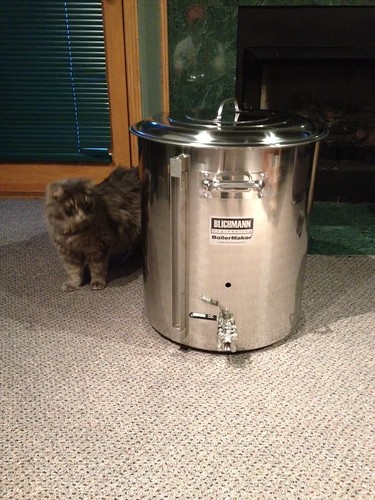
Here our cat Maggie was checking out the new addition.

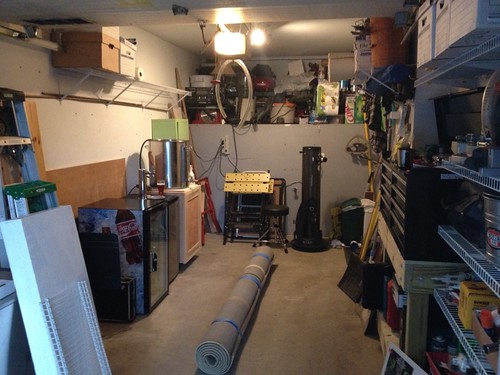
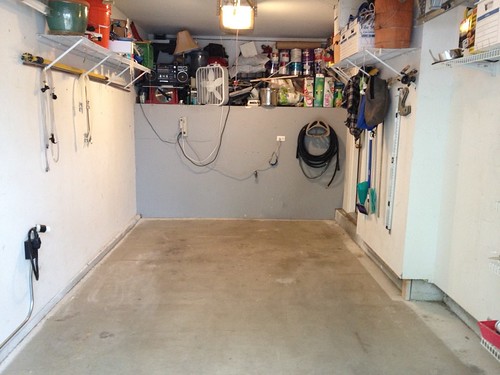
Here is basically what the garage space looked like when we started this. I do have the boil kettle in here on top of a cabinet on the left. As you can see it was pretty cluttered, and needed a gamplan to get turned into a place to brew.


After getting the boil pot built, and running a 30amp 240 volt power supply, we started doing extract brews.  I should mention that throughout this entire process my brother-in-law Sam, my partner in crime has been there every step of the way helping with the build and the brewing.


We would simply plug the Boil Kettle directly into the outlet we ran for the brewery. We would lose a lot of brew through evaporation as the heating element was on the entire boil (later a temp controller would control this part), but it worked for our purposes. All-in-all we did about 4 extract brews with just this while I was ordering and building the rest of the rig.


The batches we did were:
  • Banana Ale (later renamed Not-So-Banana Ale for the lack of banana flavor)
  • Firecracker Ale  - Made for the 4th of July, had Red Hots candy put in during the boil for a little zip and red color.
  • British Brown Ale
  • Saison
 
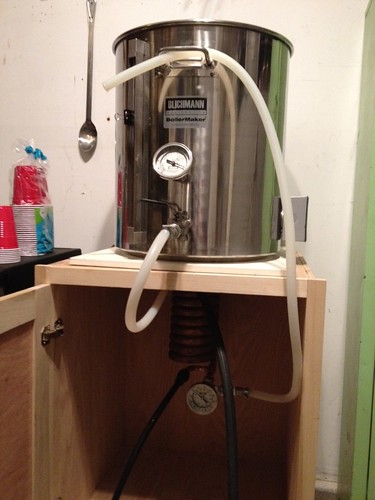
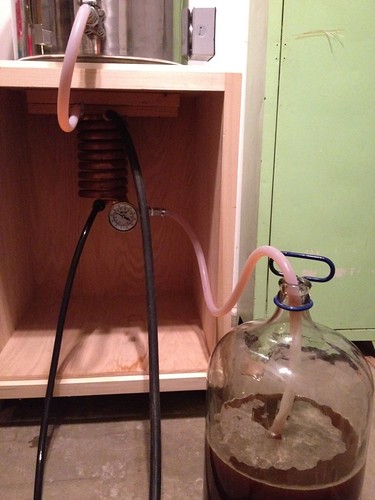
Those were just a couple of pics from an extract brew day. We learned a lot from doing this. First, a sink was going to be a game changer and we needed one. Second, we spill a little from time to time, so a protective flooring will making cleaning easier. Third, it might not be a bad idea to put up some sort of backsplash to protect the wall from the steam (a vent will help as well, but that is going to come later).

Here I cleared the garage getting ready for the new floor.


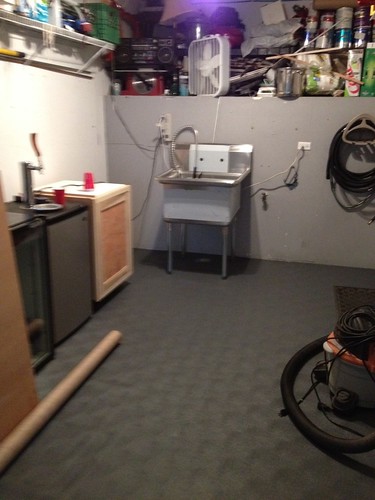
Here is an after picture once the new floor was installed, which was just in time as the next day the plumber was scheduled to install the new sink.


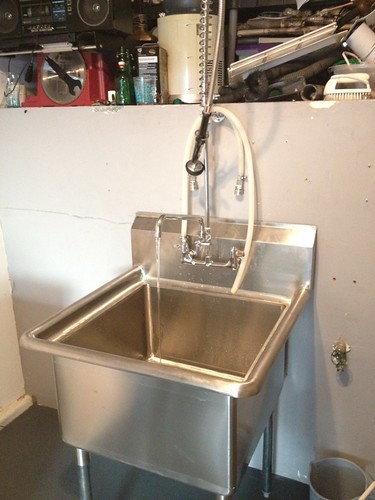
The sink after the plumber finished his work.


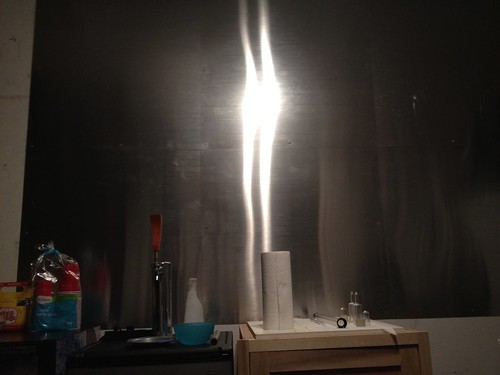
Next for the garage we put up some 3'x3' Aluminum panels we got from Home Depot to make a backsplash.  This would cover everything behind the brew stand.


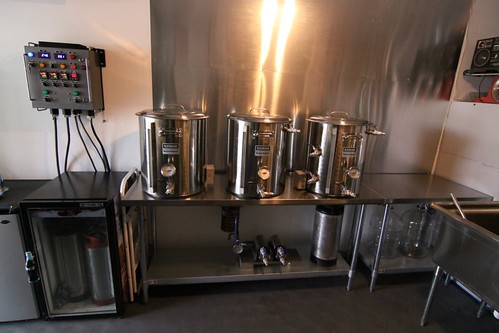
Finally, the new Stainless Steel tables arrived. I threw a couple of pots on for a quick pic to get a feel for the new rig.  At this stage we still had the control panel to complete, pumps to mount, counter-flow wort chiller to mount, lots of work on the kettles directly in adding valves, etc...  However it looks like a brewery here!


The focus then moved to building the control panel.

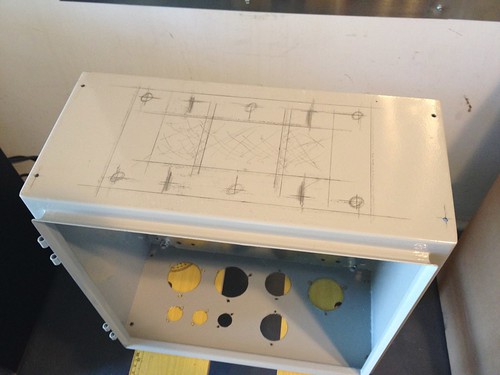
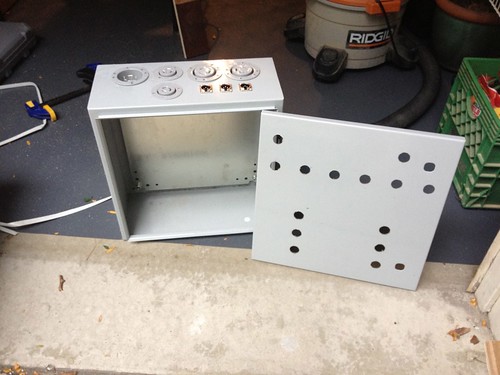
I bought all of the parts from Spike Innovations to put together myself. For a while I thought I would get the holes cut in the control panel via waterjet, but I had trouble getting a reasonable price from a place here in town so I decided to just cut them myself.


After the holes were complete, I did a quick dry fit to see how everything looked in place.


Next step was painting, then starting the wiring.


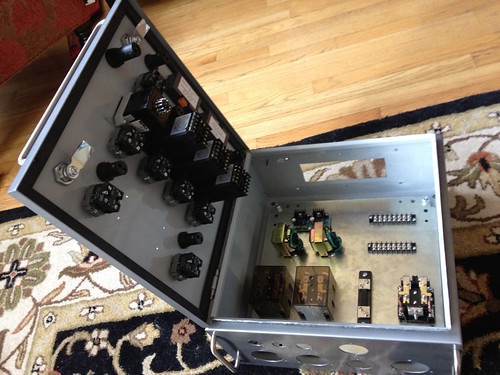
Finally the wiring is complete!


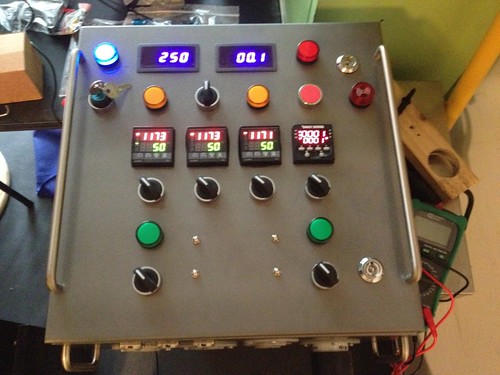
It's alive!


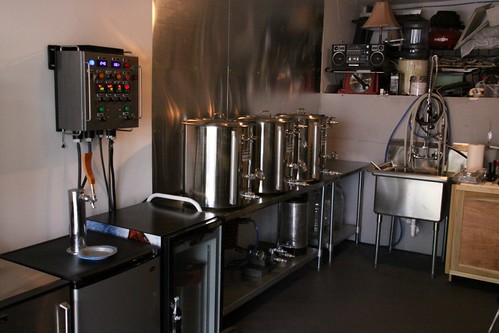
Here is the garage with everything mounted, and system working.  For our first batch we brewed a Dogfish Head IPA clone recipe I found.  I'm going to start logging our brews on this site to keep record.


Loving the new system, you'll have to stop by for a beer sometime!

Monday, March 05, 2012

New Shoes

I feel it is an unwritten rite of passage when you officially don't care what your running shows look like. It is funny to me that there are often signs on the walls in the running stores that discuss shoe color briefly to tell you to relax. Signs like "Your feet don't care what color your shoe is".

If you take a look at most of these shoes, they are a combination of some loud color, then some neutral colors around it. They almost look like the colors were decided by a dart board. Sometimes those combos look awesome, sometimes just crazy. Crazy colors seem to be a theme with running gear though including shirts, hats, jackets. I understand the need to be visible at night, but often reflective gear takes care of that.

My hip started hurting recently and a friend of mine indicated he thought it was time to change my shoes. My current running shoes were almost a year old now, so it seemed to make sense. I went to Fleet Feet where they took video of my run to look at in slow motion. First they started with me wearing a neutral support shoe. Watching my foot hit the treadmill was painful to watch. My heel hit first on the outside, then it rolled into my arch to where my ankle looked like it was going to collapse deforming my leg between my foot and calve.

Turns out the last shoe I bought was right on for the support I need, so it really came down to comfort from there. I ended up going wi the newer model of my shoe, the Asics Gel 2170. Watching me run in those were night and day on the camera, much better. As for the colors, they are grey with screaming neon green laces and highlights.

My hip feels mostly healed now after taking two run days off. I'm sure my heart will make me breath heavy my next run out, but it generally only takes me two runs to get back in the groove with this short of time off. Tomorrow I will try to log my first miles in my new shoes, knock out a 3 mile light jog.

Later this month, Shamrock Shuffle!

Thursday, February 23, 2012

Training Going Well

Sunday was a busy day. Though a three day weekend, Heather wanted to get started on painting the living room. The 13ft ceilings sold us on the house, but now that I had to paint it I was not as excited to have them. The painting ended up taking most of the day starting with a trip to Home Depot, then moving the furniture around, prepping the walls, then finally painting.


We only attacked three of the walls, as the fourth wall runs the entire length of the house from front door to back door. Anyway it was enough work to make me pretty tired as we probably invested about 8 hours into the project that day. Afterwards I was dreading the idea of running. It was to be a long run day, on top of being tired, I just knew it was going to be difficult.

I had washed my running gear earlier in the day, but still needed to dry it to wear. While my clothes were drying I went into the bedroom to spend some time with Maggie (out cat) because we had her locked up in there all day so she wouldn't get in trouble with the painting. She was not happy being locked in the bedroom, so I put her on the bed with me and we hung out. During that time I started to fade, I wanted to nap petty bad, I knew this run was going to be rough. Not only was I a little sore, now sleepy too.

Finally the dryer finished, so I wasted no time in getting suited up. Applying the Nike phrase "Just Do It", I was just going to do my run and get it over with. I have been using the Smartcoach app on Runner's World, so I looked up the length of my run online, crossing my fingers for only 4 miles, not 5 miles. It was 4 miles, I felt a small victory.

The training goal that day was for 4 miles at a slow pace, I was down with that. I started out at what felt like a trot, a pretty slow jog. I didn't bother looking at my pace, I was going to go slow. My Nike + app was talking me though I was running 10 min miles? This thing always exaggerates distance a bit, so I didn't read too much into it.

I set my audio updates on my Nike app to .5 mile updates. Two miles into this run, I could not believe it but my heart rate was a low 165. A couple of weeks ago when I started running without walk breaks, my heart was shooting up to 175 in the first 10 min of the run. To be half-way in today and have this low a heart rate really gave me a ton of confidence. Onto mile 3, still low heart rate, however my pace seemed faster than I meant it to be when I started, though I felt like I was running a slow pace the whole time.

Finally I hit mile 4 on the Nike app, but I knew the app would get there faster, so I checked my watch and I was at 3.85 miles. It was closer than I thought it would be. I continued on to finish the 4 miles on my watch, and checked out the summary. I averaged an 11 min/mile pace, which was fast than I thought I was running. My max heart rate never went above 167! I also felt like I had a ton of energy!

What a turn around from when I started! I was dragging earlier, now I felt great, like I could have run 5 miles easy. It was also my first complete run with such a low heart rate. After the run I drank a recovery drink, stretched every muscle in my legs I could, grabbed some food with Heather from Portillo's (I was craving a burger, haven't had one in ages), then iced my legs while I watched a movie.

Just is still out on the icing, but I painted again all day today and my legs felt fine, so maybe there is something to this recovery routine. I will try it again this week to see if I have similar results. I am writing this only my way to Vegas, so I will have to get a little creative as my running routine is a little different on the road.

I managed to stretch out a single run was too far in this post....


Friday, February 17, 2012

Catch up

I seem to start a few posts out this way saying "It has been a while since I've posted". I really need to get better about that. Few new items, Heather and I have booked at trip to the Virgin Islands in May. Looking forward to a beach vacation. The running is going well. Have some updates in this area.

Since my last post, I realized shortly after that time I had simply depleted myself too much. I carried around this ache that didn't go away, and I believe it was because of a few things. First thing I noticed a trend in my heart rate stats that showed my running in the 90% + range for most of my runs. This got me looking into heart rate zones. I quickly learned how your body gets and burns energy differently between your Aerobic, Anaerobic, and Max zones. I believe as I was pushing the upper limit for so much, my body was robbing from itself to get the needed energy, and not in a good way. I probably depleted some muscle along the way, took nutrients from joints, etc..., wherever it could get it. If I slowed my pace down a bit then I could be in a zone where more fat and glycogen are burned, so that is what I did.

Shortly after these realizations I focused on eating well to bring my energy reserves up, and I slowed way down my runs. I was so focused on doing that run program as outlined in the book, I neglected to realize it was burning me out and I should listen to my body more. There were actually a couple of days where I simply fast walked for an entire workout. After I was feeling better which didn't take too long, I modeled a new routine based roughly on the program I was on. That being the first run was the long run, the second run was the shortest one, and the third run of the week fell in between followed by two days rest.

This new program worked well, and before long I had actually run a 60 min run covering 5.5 miles. However I then noticed a new pattern, which is after 4-5 weeks of running where I am pushing to new levels, I need a recovery week. This simply means doing a run week from about 3 weeks ago, or simple runs. At the end of these 4-5 week cycles I also found myself getting sick each time. This to me also reinforced the idea that I needed to recover and stop pushing for a small period.

Last week I completed a recovery week, but decided to try something new on my easiest run of the week. I decided to not do any walk sessions during the run. Most times on my easy runs I would run for 5 minutes, walk for 1 minute, and do that 6 times. I decided to go for a straight 3 mile run. I figured to do this it would be good to run with others so I ran with the Fleet Feet fun run group on Wed night that week. They don't stop to walk, well they would if I did, but I could tell they don't normally walk so I knew this would be good. I was able to complete the run, but it did push my heart rate up to around 177.

I need to go back a step first. After my last 4-5 week session I felt like I hit a plateau. I wasn't losing any new weight, and I wasn't gaining speed or distance. If I was it was slight. Granted during this time I also had Superbowl parties, Championship football parties, and travel which did not have me eating as good as I was before, so I don't discount the impact of my diet during this time. Looking at my data though I began to consider the fact that maybe in scaling back my running limits, I wasn't allowing the growth. So I decided to adopt a new approach which is to not spend most of my run in a max heart rate zone, and not spend none of the run in that zone. Instead I would end my runs pushing myself into that zone for a few minutes.

Back to my first run with no walks. I did get into a higher heat rate zone earlier in the run than I wanted. However since it as a shorter run I pushed through. My next run I slowed my pace down a little, and just tried to do 3 miles again. This time was better, I still peaked around the same but my heart took a little longer to get there. I also had to do that run on the treadmill because it was snowing out, man do i not like that treadmill. After that run I had two days rest and decided to take on a 4 mile run outside. This run went similar to my second run, but I did finish. I also started noticing how the runs felt longer to me, or time was slower. Before I could run for an hour, but with those walk breaks, it broke everything up and time flew. Now with nothing to break the runs up it felt like it was going on forever.

My next run I decided to just do 3 miles, simple run. The good news is my heart rate stayed down below 170 until about the last 10 minutes. I was definitely getting better here. The run was going so well I decided to push myself the last 5 minutes to see what kind of 5k time I could get. I ended up around 31:20, which is 3 minutes better than my 5k at Thanksgiving. This brings us to yesterday's run.

I had created a new run program using Runners World's Smartcoach in preparation for the Shamrock Shuffle race I signed up for at the end of March which is an 8k race. Yesterday's run was to be a tempo run. First I had to look that up. I was to run 1 mile pretty slow as a warm up, then 2 miles at a pretty good pace, then the last mile slow like the first. To try and address the time slowing factor I changed the audible updates on my Nike + app to only tell me status at the end of each mile. I think this helped because this 4 mile run felt normal for time like before. Anyway I completed the time, and seem to be getting faster in my runs now too. I think that pushing myself a bit more during a little bit of my run is having a good impact.

I think I am starting to drop a little more weight now, am speeding up, have gotten out of the mode of doing small walk breaks in my runs, and am passing the time better. Now the downside, or possible upside, is that I feel my legs a bit more sore. I just need to be careful not to let things get too sore, and to avoid getting sick if possible.

I am also considering adding strength training to my days I'm not running. I think that change will also help boost my weight loss, and because I fear I lost some muscle when pushing myself too much before, I want to build it back up a bit. I find myself really having to psych myself up for this stuff though, because I know it means I am exercising 6 days a week as opposed to the 3 I am doing now. In addition I am going to go through a very sore period with my muscles as I always do when starting something like this. So right now I am trying to craft what that routine will look like. I might start it after next week because next week I am in Vegas and the gym at the hotel is difficult to do real weight lifting.

The target time I would like to hit for the 8k race, which is 5 miles, is 52 minutes. I don't think it is impossible to even hit 50 minutes, but I also don't discount the fact that as there are some hills on this race course, and I will probably start faster than I mean to, I might get a slower time. I won't be disappointed with any time, will just be happy to do the race, and hopefully surprised if I finish stronger than anticipated.